
Kalawao Weekly Arrest Log Status
Kalawao County lists no multi-day blotter. There is no 72-hour list and no seven-day list. No monthly report exists. No searchable arrest archive is online either. No page depth, rolling window, PDF series, posting schedule, or photo rule exists to describe. The honest answer is a map of sources. It is not an empty table dressed up to look like live arrests. The county's unusual structure explains the gap. The state Department of Health runs the Kalawao sheriff role. National Park Service officers may hold their own park incident records. Maui Police can step in through mutual aid or pick up a Molokai-connected record. DCR keeps state custody records after intake. Each system covers a different stage. Any broad weekly query should split into agency, court, custody, and news checks.
Wailuku Arrest Log Access
One access point does exist. A September 4, 2026 Maui Now report on MPD disclosure practices states that arrest logs can be reviewed at the Wailuku police station receiving desk at any time. That desk is a physical MPD access point. It is not an online Kalawao blotter. Nothing in the reporting promises that every Kalawao sheriff or NPS event shows up there. The article mainly documents how MPD handles routine releases today.
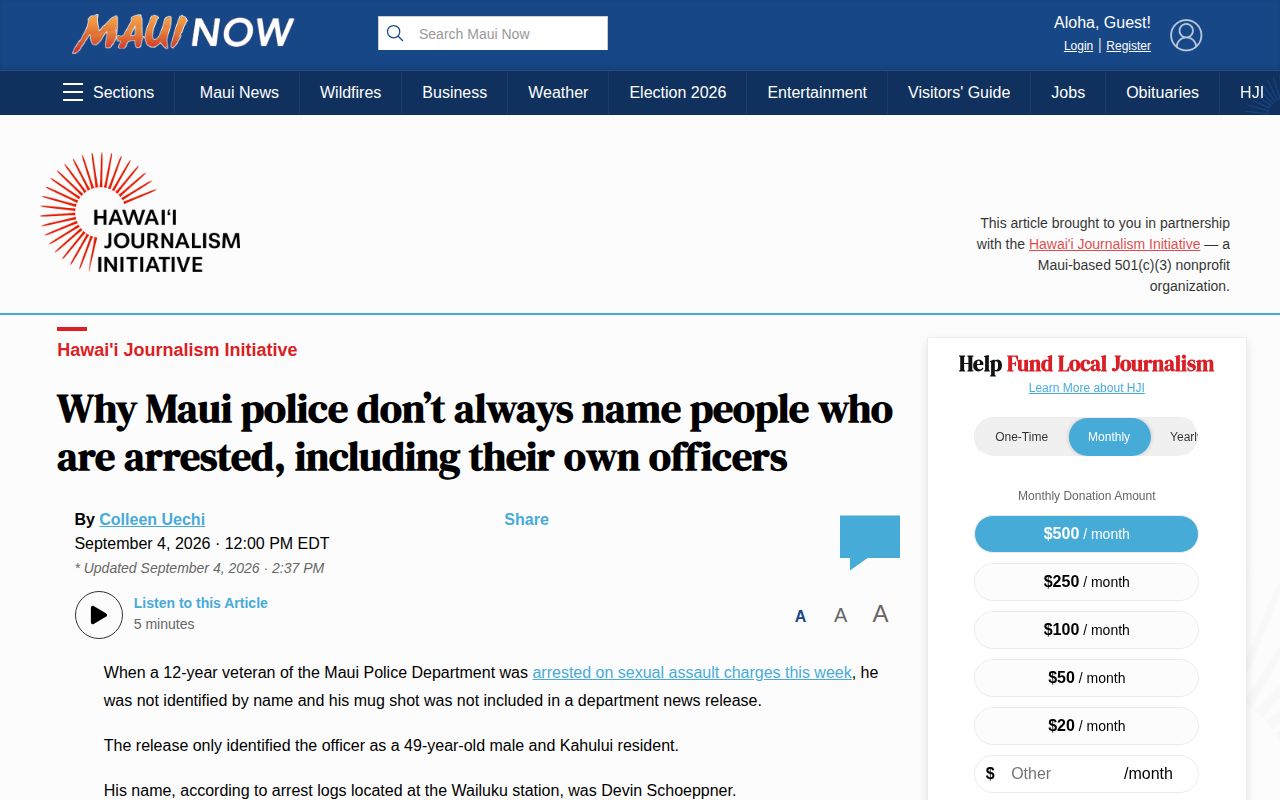
Treat that Maui Now report as journalism. It is not a roster of people booked in Kalawao County. The same report says MPD stopped routinely publishing names, mugshots, or identifiers. A policy change drove the stop. Disclosure now happens only when it serves public safety or crime prevention. That makes the local distinction concrete. A log may sit open for inspection. A press release can still omit every single identifying detail. The official MPD records page remains the government route for requesting a report.
Read a Kalawao Arrest Blotter
With no countywide blotter to page through, build the multi-day record from dated official sources. Keep four columns. Agency records, custody records, court filings, and news stories each stay separate. That discipline matters. It keeps a later court event from being mistaken for the original arrest.
- Set the event range. Use exact start and end dates, including the Hawaii time zone, and note whether a weekend or holiday falls inside it.
- Name possible custodians. Check DOH/Kalawao, NPS, MPD, and DCR according to the place, officer, transfer, or facility information known.
- Request MPD material where relevant. Inspect the Wailuku log if practical, or use the official Public Records Request Portal for an MPD-controlled report.
- Search the court trail. Use eCourt Kōkua for filed cases and confirm the circuit rather than assuming all Molokai events take the same path.
- Check state custody separately. Hawaii SAVIN can show covered DCR status, but it is not an arrest archive.
- Review local news last. Treat an article as a lead and verify its charge, date, agency, and later disposition.
For same-day checks, the Daily Arrest Report covers the immediate window. A weekly search needs more patience, since reports get finished after the event, court filings land later, and news dates rarely match arrest dates.
Kalawao Arrest Log Entry Fields
Kalawao publishes no public schema for log entries. Treat these fields as things to pull from the source record itself. Keep each source's own wording, and mark anything unsupported as unknown.
| Field | How to read it |
|---|---|
| Name as recorded | Keep spelling, suffix, and aliases distinct; do not merge similar names. |
| Event date and time | Separate arrest, report, booking, publication, transfer, and court timestamps. |
| Agency and location | Identify DOH/Kalawao, NPS, MPD, DCR, or another office and the recorded place. |
| Report or case number | Use the proper identifier to bridge an agency record to a court file. |
| Arrest basis | Record warrant, probable cause, citation, summons, or other basis exactly as stated. |
| Charge at that stage | Treat it as an charge that can be amended, dismissed, or resolved without conviction. |
| Custody movement | Record a release, hold, or transfer only when an official source supports it. |
| Photo source and status | Do not call a news image a booking photo unless the source identifies it that way. |
| Court disposition | Add the later outcome from the court instead of inferring it from the arrest entry. |
A complete multi-day record often takes several sources. The agency report shows what officers wrote down. DCR or SAVIN answers whether state custody followed. The court file shows what was charged and how it ended. None of them replaces the others.
Weekend Kalawao Arrest Reporting
No source publishes a Kalawao-specific weekend or holiday cadence. Claiming a surge, a Monday batch, or a fixed delay would simply be wrong. What is true: each stage runs on its own clock. A report may still be unfinished. A person may be transferred. A court case may not yet exist. A news account may wait for officials to speak.
Search a range that spans the event day plus later working days. Write down the event date and the date of each search. If the Wailuku desk matters, remember that physical availability is not online access and does not cover all of Kalawao. For DOH, NPS, and DCR records, request the exact date span and ask whether material is still active, moved to another custodian, or withheld.
Kalawao Arrest News Is Selective
Molokai-area arrest and public-safety coverage comes mostly from three outlets. Molokai Dispatch, Maui News, and Maui Now carry it. None promises a full Kalawao County list. Editors pick stories based on public interest, space, and sourcing. An article might cover an MPD action, a court development, or an official statement. It may not reveal every booking field. The Molokai Dispatch drug-bust report shows the outlet's enforcement coverage. It is news reporting, not an arrest feed.

News coverage of Kalawao arrests is spotty, so cast a wide net. Search archives under Kalaupapa, Kalawao, and Molokai, then narrow by the named agency and a date range. Keep two dates straight. The story's publication date and the date of the arrest are rarely the same, and mixing them wastes time. A follow-up article may report dismissal, acquittal, or another outcome. Link that update back to the original arrest report, and take any correction to the right desk: the newsroom fixes story errors, while the official record custodian handles agency-record mistakes.
Compare Kalawao News Archives
Each outlet offers a different discovery path. Start with agency and court sources, then turn to these publications, clearly labeled as journalism.
| Source | Useful role | Limit |
|---|---|---|
| Maui News local news | Maui, Molokai, and Lanai reporting, including police and court developments. | No complete Kalawao booking archive or assured photo type. |
| Molokai Dispatch | Geographically focused community coverage and selected public-safety stories. | Stories are selective and not a daily or weekly official log. |
| Maui Now crime coverage | Procedural reporting, statistics coverage, and selected Maui-area events. | News content does not replace MPD, DOH, NPS, DCR, or court records. |
The Maui News local section capture shows a publication index rather than a roster.

Its section can surface older stories, but a missing story cannot disprove an arrest.
Unofficial Kalawao Arrest Indexes
Kalawao has no dependable presence on the big private mugshot aggregators. Busted Newspaper carries no live county page. Recently Booked and Mugshots.com serve none either. Arrests.org blocks access outright. A serious Kalawao arrest search therefore has to lean on official sources. Private arrest-site listings appear and vanish.
Search results do turn up Kalawao landing pages from time to time. Most are thin index pages with no tie to any agency. They offer no steady publication cycle. They give no official booking photo and no clear path to a correction. Treat any arrest named there as unconfirmed. Wait until the originating agency or the court backs it up. A stale private page can also miss a reduced charge or a later ruling.
Corrections work best at the source. When an official record is wrong, ask its custodian to fix it. When a news story is wrong, hand the newsroom official proof. Search engines will refresh an old result only after the source itself changes. Hawaii also offers a state expungement route for eligible nonconviction records.
Kalawao Arrest Archives and Retention
The State Archives is not a live Kalawao arrest search. Its retention and disposition schedules spell out when agencies keep, move, or destroy files. A record may sit inactive at the State Records Center. The agency still owns it. DOH and DCR follow their own schedules. Maui County schedules govern MPD material. They do not automatically control Kalawao sheriff or NPS records.
For an older record, ask the custodian which schedule applies. Ask whether the file is active. Ask whether it moved. If the file was lawfully destroyed, the office should say so. For an MPD report, use the official online portal. Fax works at 808-244-6418. Mail goes to MPD Records Section, 55 Mahalani Street, Wailuku, HI 96793. Or call 808-244-6355. The ten-business-day estimate covers most reports. It is not an archive deadline.
A DOH request should name the sheriff program and the date range. NPS ranger records go through NPS FOIA. A DCR request should name the facility and custody period. Court complaints and final dispositions must be searched as court records.
Note: A retention schedule governs agency handling; it does not create a public, searchable Kalawao arrest-log archive.
Confirm Kalawao Arrest Dispositions
An arrest entry only opens the story, since charges can be declined, reduced, amended, or dismissed. Match the incident or report number to the court case. Then read the final disposition instead of an old headline.
Court routing trips people up. The District of Kalawao sits in the First Circuit. Ordinary Molokai cases belong to the Second Circuit. Location alone can point you to the wrong clerk. Use eCourt Kōkua and the Judiciary's court-location information, then confirm the court through the agency or case number.